The Philippine construction industry is at an inflection point. Infrastructure demand is accelerating — from large-scale transit systems and airport expansions to high-density residential towers and mixed-use commercial developments. Against this backdrop, the methods contractors use to deliver these projects are under scrutiny like never before.
The central question: does traditional cast-in-place construction still serve the demands of modern project delivery? For a growing number of EPC contractors in the Philippines, the answer is no — and the shift toward precast methodology is not a trend but a deliberate, engineering-driven decision.
What Traditional Construction Actually Means
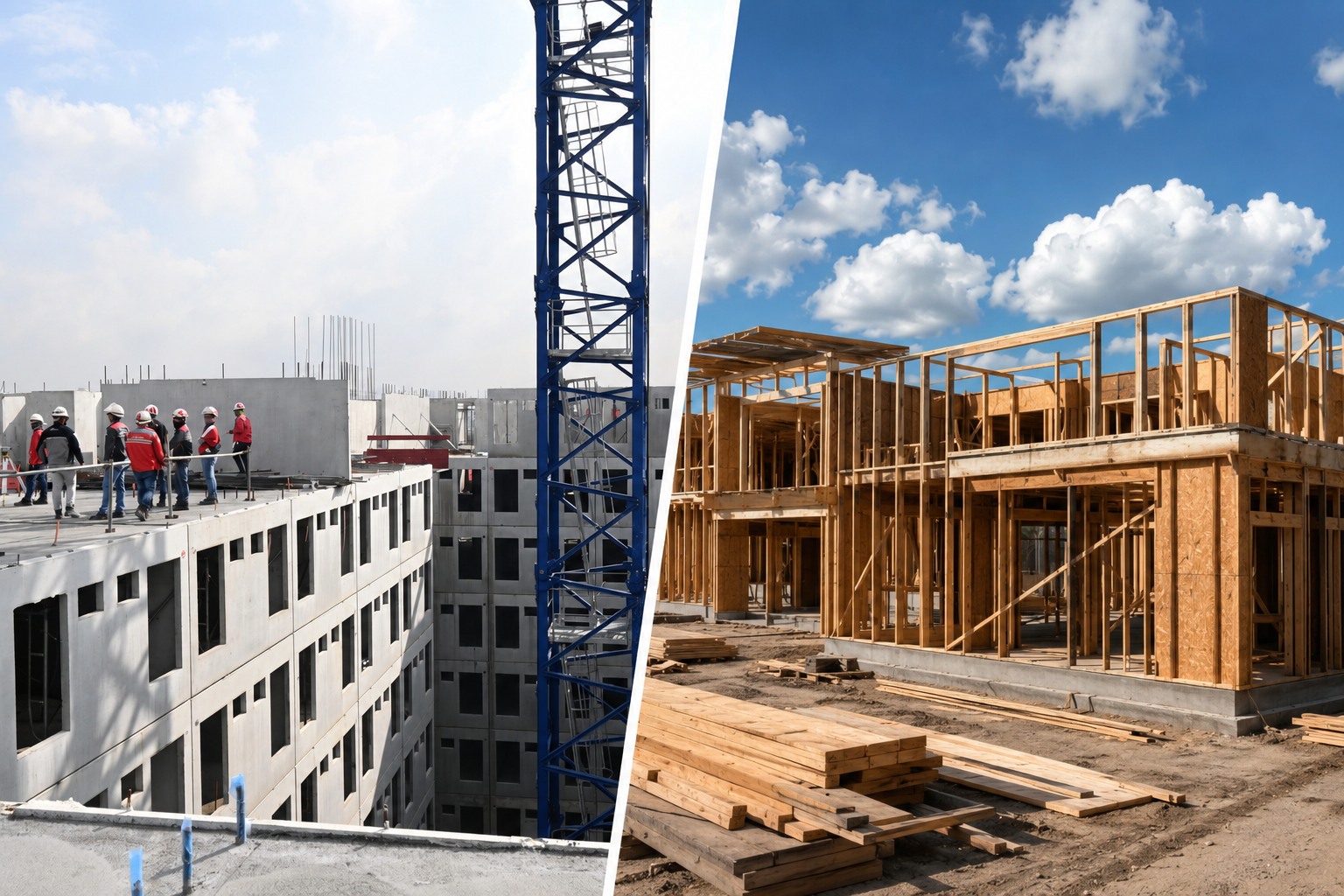
Traditional cast-in-place construction involves mixing, pouring, and curing concrete directly on a project site. Structural elements — columns, beams, walls, slabs — are formed using temporary formwork erected by workers, filled with wet concrete, and left to cure for up to 28 days before they reach full structural strength.
This method has been the foundation of construction practice in the Philippines for decades. It is familiar, flexible, and widely understood across the industry. But it also carries inherent limitations that compound as project scale and complexity grow:
- Curing time is fixed and cannot be safely compressed
- Output quality varies with site conditions — temperature, humidity, worker skill, and supervision levels all introduce variability
- Active formwork occupies floor space and restricts parallel work activities
- High volumes of on-site labor increase safety exposure
- Weather disruptions — particularly significant in a typhoon-prone country — can halt progress for days at a time
These are not failures of execution. They are structural characteristics of the method itself.
The Precast Difference: Engineering, Not Just Assembly
Precast concrete construction moves the manufacturing of structural elements off-site and into a controlled factory environment. Columns, beams, girders, shear walls, core walls, hollowcore slabs — each component is cast in precision molds, cured under carefully managed conditions, inspected for quality before dispatch, and then transported to the project site for installation.
The difference is not simply logistical. It is fundamentally about where risk is managed.
In cast-in-place construction, quality is verified after the concrete is poured and set — a point at which deficiencies are expensive to correct. In a precast plant, quality is controlled throughout the production process. Every element undergoes inspection before it leaves the facility. Because precast concrete forms are created offsite, all products can be inspected for defects before shipping out, and the controlled process eliminates unknowns related to temperature, humidity, and imprecise tools.
The structural implications are equally significant. Precast concrete is considerably stronger than site-poured concrete — the main reason for its higher strength lies in the superior quality of materials and the curing process in a tightly controlled environment. This translates directly into better-performing structures over their full lifecycle.
Schedule: Parallelism as a Competitive Advantage
One of the most commercially important advantages of precast construction is schedule compression through parallel production.
In traditional construction, the sequence is largely linear: prepare the site, erect formwork, pour concrete, wait for curing, strip formwork, repeat. Each floor cycle depends on completing the one before it.
Precast construction breaks this dependency. While excavation and foundation work are completed on-site, precast components can be manufactured simultaneously in a factory. This parallel production minimizes downtime and accelerates overall project schedules, enabling developers to meet tight deadlines. On projects where parallel production is fully optimized, the construction timeline reduction can be substantial — weeks or months, depending on project scale.
Because precast elements are finished to specification, the crew spends less time mixing, pumping, or finishing concrete on the ground. Factory curing also reduces shrinkage cracks and finishes that would otherwise need on-site patching. Both factors translate directly into faster project completion and lower rework costs.
In the Philippine context, weather is an additional variable that traditional construction must absorb. Rainy season, typhoons, and extreme heat create unpredictable disruptions for on-site concrete works. Precast production in a controlled facility is unaffected by these conditions, providing schedule reliability that matters significantly when projects have fixed delivery commitments.
Quality Control: From Variable to Verifiable
Quality in traditional construction is largely a function of the people on site on a given day — the skill of the concrete crew, the vigilance of the QA officer, the consistency of the ready-mix supplier. Under ideal conditions, this can produce excellent results. But ideal conditions are not guaranteed.
In a precast plant, quality control is systemic. Since precast concrete is mixed, poured, and cured at the plant, ideal conditions and measurements are maintained throughout the process. Stringent strength requirements are met before any element leaves the facility. Consistency is built into the production system, not dependent on individual site performance.
This shifts the quality paradigm from reactive to proactive. For a contractor managing dozens of structural elements across multiple tower floors, the ability to verify quality at source — rather than inspecting on-site after the fact — is operationally transformative.
Safety: Fewer People on Site, Lower Risk
Construction sites are inherently high-risk environments. The combination of heavy equipment, elevated work platforms, and large labor forces creates exposure to injury that requires constant management. Precast construction addresses this at the source.
With most of the construction activity — including the heavy lifting of large panels — taking place off-site, the potential for accidents and injuries is significantly reduced at the construction site. This is particularly important in densely populated urban areas or in projects with tight construction spaces. A smaller on-site footprint also means less disruption to surrounding communities and better compliance with municipal construction regulations.
Megawide Construction’s Precast Ecosystem
Megawide Construction does not treat precast as a single tool. We have built an integrated precast ecosystem — spanning manufacturing infrastructure, engineering methodology, technical licensing, and installation capability — that operates end-to-end under one roof.
The Manufacturing Foundation: PCS by Megawide
The backbone of our precast capability is Precast and Construction Solutions by Megawide (PCS), our dedicated manufacturing arm. PCS operates a purpose-built industrial facility in Taytay, Rizal, housing the precast plant and stockyard, formworks main yard, and logistics motor pool — all under one integrated operation.
The scale of this infrastructure is significant: the main plant carries a production capacity of 140,000 m³ per year, supported by a secondary Taytay facility with an additional 30,000 m³ per year capacity. This is not a supplementary operation. It is purpose-built manufacturing infrastructure designed to serve large-scale project delivery at consistent volume.
The product range PCS manufactures is comprehensive: precast columns, beams, half slabs, hollowcore slabs, exterior and interior walls, stairs, bathroom units, and housing units. These elements are produced under factory-controlled conditions, inspected before dispatch, and transported directly to project sites using Megawide’s own logistics fleet — ensuring quality is verified, and delivery is controlled, at every stage of the supply chain.
Advanced Engineering Methodologies
On top of the manufacturing capability, we deploy licensed and proprietary engineering methodologies that push precast performance further.
SQRIM — Southeast Asia’s First Licensee
We are the first licensee in Southeast Asia of SQRIM (Sumitomo-Mitsui Quick RC Integration Method), an advanced full precast technology developed by Sumitomo Mitsui Construction Co., Ltd. (SMCC) of Japan. SQRIM is a construction method using precast columns and precast members consisting of an integrated beam and beam-column joint. It is completely made up of precast concrete and eliminates the need for cast-in-place concrete at member connections — making it possible to build with significantly shorter construction periods at a speed comparable to those of steel structures.
This is a meaningful distinction in the Philippine market. Most precast systems still rely on cast-in-place concrete at key structural joints, reintroducing the variability and curing delays that precast is designed to eliminate. SQRIM removes this dependency entirely at the most structurally critical connections.
Rebar Coupler Technology
Rebar Coupler Technology provides faster, stronger, and more reliable connections between reinforcing bars, enhancing structural performance and durability. Adapted to Philippine construction standards for compatibility and safety, it reduces labor time, minimizes material waste, and improves construction efficiency throughout the project lifecycle.
The Outcomes in Practice
At Urban Deca Ortigas — a large-scale affordable residential development in Pasig comprising 22 mid-rise buildings and over 19,000 residential units — our 90% precast construction methodology is delivering consistent, high-quality output at scale. Pre-painted exterior walls, precast toilet pods, shear walls, and integrated stair systems arrive on site ready for installation. This is not a prototype; it is the operating standard across a major live development.
The breadth of Megawide Construction’s precast application — from landmark airport terminals (Mactan-Cebu International Airport, Clark International Airport) to large-scale mass residential — reflects a methodology that scales across project types and delivers consistently across all of them.
Why This Matters for the Philippine Construction Landscape
The Philippines faces a substantial and sustained construction demand. National infrastructure programs, urbanization pressure, housing backlogs, and private sector development are driving project pipelines across the country. Precast concrete offers a quicker and more efficient construction solution to meet these demands and accelerate infrastructure growth.
Additionally, the Philippines is prone to natural disasters, including earthquakes and typhoons. In this environment, the structural consistency and inspectable quality of precast construction are not optional enhancements — they are design imperatives. Precast concrete technology has demonstrated its ability to enhance the structural resilience of buildings and infrastructure.
For developers and project owners, the choice of construction method is increasingly inseparable from the choice of contractor. A construction company in the Philippines that has invested in purpose-built precast manufacturing, licensed advanced methodologies, maintains its own logistics fleet, and trained specialist teams to install full precast systems is operating at a fundamentally different capability level. That difference shows up in schedule reliability, structural quality, safety performance, and long-term cost.
The Direction is Clear
Traditional cast-in-place construction will not disappear from the industry. It remains appropriate for certain project types — particularly where components are too large to transport or where site conditions preclude precast logistics. But as the default methodology for vertical and horizontal construction in the Philippines — from mid-rise and high-rise towers to socialized and affordable housing developments? Its limitations are increasingly difficult to justify against the alternatives.
The application of precast to housing is not theoretical. Megawide Construction is actively deploying precast methodology across the housing sector, including medium-rise residential developments under the government’s Expanded Pambansang Pabahay para sa Pilipino Program (Expanded 4PH), with a target of constructing more than 7,000 housing units in Cavite. The goal is not simply to build more homes — it is to build them faster, at consistent quality, and at a cost that keeps them within reach of Filipino families. Precast methodology is what makes that equation work.
The leading EPC contractors in the Philippines are not switching to precast because it is fashionable. They are switching because the outcomes — in schedule performance, structural quality, safety, and project costs — consistently favor it.
At Megawide Construction, precast methodology is not a capability we are building toward. It is the standard we already deliver.